The Last Refrain
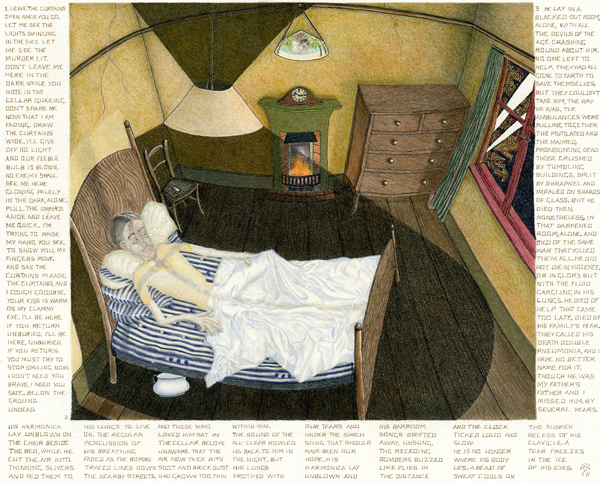
This pen, ink and coloured pencil picture won an award at the UKCPS International Exhibition 2012. The text around the edge is part of a novel in progress, and reads:
‘Leave the curtains open when you go. Let me see the lights swinging in the sky. Let me see the murder lit. Don’t leave me here in the dark while you hide in the cellar quaking. Don’t spare me now that I am disappearing. Throw the curtains wide, I’ll give off no light and our feeble bulb is blown. No one will see me here glowing palely in the dark alone. Pull the drapes aside and leave me quick, I’m trying to raise my hand, you see, to show you, my fingers move, and say, the curtains, please, the curtains, and I cough goodbye. Your kiss is warm on my clammy eye. I’ll be here if you return unburied. I’ll be here, unburied, if you return. You must try to stop smiling now. I don’t need you brave. I need you safe, below the ground. Undead.
His harmonica lay unblown on the chair beside the bed, while he cut the air into thinning slivers and fed them to his lungs to live on. The regular snatched percussion of his breath faded as the bombs traced lines down the nearby streets, and those who loved him sat in the cellar below, unaware that the air now thick with soot and brick dust had grown too thin within him.
The sound of the all clear howled us back to him in the night, but his lungs frothed with our tears and under the siren song that should have been our hope, his harmonica lay unblown and his bar-room songs drifted away, unsung. The receding bombers buzzed like flies in the distance and the clock ticked loud and slow.
He is no longer where his body lies. A bead of sweat cools on the sunken recess of his clavicle. A tear freezes in the ice of his eyes.
He lay in a blacked-out room, alone, with all the devils of the age crashing round about him. No one left to help. They had all gone to earth to save themselves, but they couldn’t take him, the way he was. The ambulances were pulling together the mutilated and the maimed, pronouncing dead those crushed by tumbling buildings, split by shrapnel and impaled on shards of glass. But he died then, nonetheless, in that darkened room, alone, and died of the same war that killed them all. He did not die in violence, or in glory, but with the fluid gargling in his lungs, he died of help that came too late, died of his family’s fear. They called his death double pneumonia, and I have no better name for it, though he was my father’s father and I missed him. By several years.’
 nicolsonbrooks